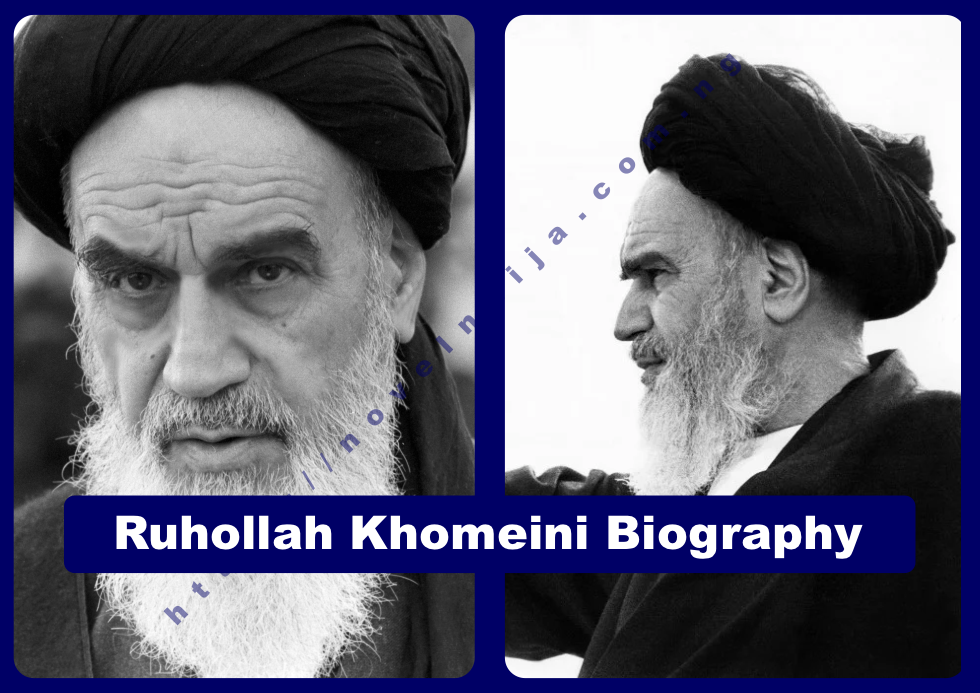
Explore the life of Ayatollah Ruhollah Khomeini, from exiled cleric to architect of Iran’s Islamic Revolution and first Supreme Leader.
Ruhollah Musavi Khomeini founded the Islamic Republic of Iran and served as its first supreme leader from 1979 until his death in 1989. He was the driving force behind the Iranian Revolution that overthrew Mohammad Reza Shah Pahlavi, transforming Iran from a pro-Western monarchy into an anti-Western Islamic republic.
What makes Khomeini’s story particularly striking is how a religious scholar in exile managed to inspire millions of Iranians from thousands of miles away, ultimately reshaping not just his own country but influencing geopolitics across the Middle East for decades to come. His concept of velāyat-e faqīh (guardianship of the jurist) created an entirely new model of Islamic governance that continues to define Iran today.
Key Details Of Ruhollah Khomeini Biography
| Field | Information |
|---|---|
| Full Name | Ruhollah Musavi Khomeini |
| Date of Birth | May 17, 1900 (or September 24, 1902) |
| Place of Birth | Khomein, Markazi Province, Iran |
| Date of Death | June 3, 1989 |
| Age at Death | 86-89 years |
| Nationality | Iranian |
| Religion | Twelver Shia Islam |
| Occupation | Cleric, Politician, Political Theorist, Revolutionary |
| Title | Ayatollah, Supreme Leader of Iran |
| Political Role | First Supreme Leader (1979-1989) |
| Spouse | Khadijeh Saqafi (married 1931) |
| Children | Mostafa, Ahmad, Zahra, Farideh, Sadiqeh |
| Notable Works | Islamic Government (40+ books total) |
| Legacy | Founded Islamic Republic of Iran |
Early Life and Background
Born in Khomeyn, Markazi province, Khomeini’s father was murdered when he was two years old. The young Ruhollah was raised by his mother, Agha Khanum, and his aunt, Sahebeth, following his father Mustafa Musawi’s murder in 1903. Tragically, both his mother and aunt died of cholera in 1918, leaving his elder brother Mortaza (later known as Ayatollah Pasandideh) to assume responsibility for the family.
Khomeini came from a lineage of small land owners, clerics, and merchants, with ancestors who migrated from Nishapur to India in the 18th century. His paternal grandfather, Ahmad Hindi, was born in Kintoor near Lucknow, and the family retained connections to India—Khomeini even used “Hindi” as a pen name in some of his poetry. This international heritage would later inform his pan-Islamic political vision.
The orphaned child grew up in a household steeped in religious scholarship. Despite the hardships of losing both parents at a young age, Khomeini displayed remarkable intellectual capabilities and spiritual devotion that would shape his future as one of the twentieth century’s most influential religious leaders.
Education and Spiritual Formation
Ruhollah began studying the Quran and elementary Persian at age six, followed by attendance at a local school where he learned religion and traditional subjects. His religious education continued under the guidance of relatives, including his mother’s cousin Ja’far and his brother Morteza.
In 1920, arrangements were made for him to study at the Islamic seminary in Isfahan, but he was instead drawn to Arak, where he studied under the renowned Ayatollah Abdolkarim Haeri Yazdi. When Haeri Yazdi transferred to the holy city of Qom in 1921, Khomeini followed and settled at the Dar al-Shafa school.
In Qom, Khomeini immersed himself in Islamic jurisprudence, philosophy, and mysticism. He became a lecturer at Najaf and Qom seminaries for decades before gaining political prominence, teaching political philosophy, Islamic history, and ethics. Several of his students, including Morteza Motahhari, became leading Islamic philosophers themselves.
Beyond his scholarly pursuits, Khomeini was also a gifted poet. Beginning in his adolescent years, he composed mystic, political and social poetry published in collections including The Confidant, The Decanter of Love and Turning Point, and Divan. His mastery of Persian poetry was so profound that fellow poet Nader Naderpour recalled spending hours exchanging verses with him, noting that Khomeini could recite the next line of any poem quoted to him.
Political Awakening and Opposition to the Shah
Khomeini’s transformation from quietist scholar to revolutionary activist occurred gradually. In 1963, when the Shah launched the White Revolution—a modernization program including land reform, women’s suffrage, and reduced clerical power—Khomeini emerged as a vocal critic.
The White Revolution threatened the traditional power base of the clergy by nationalizing forests, redistributing land held under religious trusts, and introducing secular education. In a June 1963 speech at Feyziyeh School, Khomeini attacked the Shah personally, marking a significant departure from traditional clerical political practice.
On June 5, 1963, Khomeini was arrested after declaring the Shah a “wretched, miserable man” who had embarked on the path toward destruction of Islam in Iran. His arrest sparked three days of major riots throughout Iran. After eight months of house arrest, Khomeini was released but continued his opposition, particularly condemning Iran’s cooperation with Israel and the extension of diplomatic immunity to American personnel.
In November 1964, Khomeini was re-arrested and sent into exile where he remained for 15 years, mostly in Najaf, Iraq. What the Shah intended as a silencing measure instead amplified Khomeini’s voice—from exile, he continued inspiring opposition through smuggled audio tapes and writings.
Years in Exile: Developing Revolutionary Theory
Khomeini spent his exile refining his political theology. In Najaf, he delivered a series of lectures that were compiled into his seminal work, Islamic Government: Governance of the Jurist, which outlined his theory of velāyat-e faqīh. This concept argued that Islamic jurists should not merely advise rulers but should themselves govern, as they alone understood divine law.
During his 14 years in Iraq, Khomeini built a network of followers and continued sending messages back to Iran. In 1978, Iraq expelled him under pressure from the Iranian government. After brief consideration of Syria, Kuwait, or other destinations, Khomeini settled in Neauphle-le-Château outside Paris, France—a decision that proved strategically brilliant.
From France, Khomeini had access to international media and could communicate more effectively with his followers in Iran. During the last months of his exile, he received a constant stream of reporters, supporters, and notables eager to hear from the spiritual leader of the revolution. He set the course of the revolution from Paris, urging Iranians not to compromise and ordering work stoppages against the regime.
The Iranian Revolution (1978-1979)
By the end of 1978, the revolution had become a broad-based uprising that paralyzed the country. Massive demonstrations involving millions of Iranians demanded the Shah’s departure and Khomeini’s return. The protests succeeded—on January 16, 1979, Mohammad Reza Shah Pahlavi left Iran.
On February 1, 1979, Khomeini returned to Iran following an invitation by the government, with several million people greeting him as he landed in Tehran. By February 11, the monarchy had collapsed, and Khomeini assumed leadership as guerrillas and rebel troops overwhelmed loyalist forces.
What followed was the transformation of Iran into an Islamic republic. Following the March 1979 referendum in which 98% approved the shift to an Islamic republic, the new government drafted the constitution that made Khomeini the Supreme Leader of Iran in December 1979.
This wasn’t simply replacing one autocracy with another—it was creating an entirely new form of government that blended theocracy with republican elements, where ultimate authority rested not with elected officials but with a religious jurist interpreting divine law.
Supreme Leadership and Consolidation of Power
As Supreme Leader, Khomeini held authority over all branches of government, the military, and the judiciary. He moved quickly to consolidate the Islamic Republic’s power, suppressing opposition from leftist groups, liberals, and moderate clerics who had supported the revolution but disagreed with his vision of clerical rule.
The November 1979 seizure of the U.S. embassy by Iranian students—holding 52 Americans hostage for 444 days—occurred with Khomeini’s blessing. He called the United States the “Great Satan” and used the crisis to rally nationalist sentiment and eliminate moderate voices in the government.
Khomeini also expanded his influence through the establishment of revolutionary institutions like the Islamic Revolutionary Guard Corps (IRGC) and support for militant groups abroad, including Hezbollah in Lebanon. His vision extended beyond Iran’s borders—he sought to export the Islamic revolution throughout the Muslim world.
The Iran-Iraq War (1980-1988)
In September 1980, Iraq launched a full-scale invasion of Iran under Saddam Hussein, beginning a conflict that would last eight years. Iraq’s leader hoped to exploit Iran’s post-revolutionary weakness and prevent Khomeini from exporting his Islamic ideology to Iraq’s Shia majority population.
The Iranian military, despite being weakened by revolutionary purges, mounted fierce resistance, and by early 1982 had regained almost all territory lost to the invasion. However, Khomeini refused to accept peace offers, instead launching offensives into Iraqi territory with the goal of toppling Saddam’s regime.
The war became a brutal stalemate characterized by trench warfare, chemical weapons attacks, and devastating casualties. Khomeini used human wave attacks, promising soldiers they would automatically enter paradise if they died in battle. Young men, including children, volunteered for the Revolutionary Guard, driven by religious fervor and patriotic duty.
The conflict exacted a terrible toll. By March 1984, two million of Iran’s most educated citizens had fled the country. The war drained Iran’s economy and cost hundreds of thousands of lives. In July 1988, Khomeini finally accepted a UN-mediated ceasefire, describing it as drinking “the cup of poison”—a bitter admission that victory had proven impossible.
The Rushdie Affair and International Controversy
In early 1989, months before his death, Khomeini issued one of his most internationally controversial declarations. He issued a fatwa calling for the execution of British-Indian author Salman Rushdie for his novel The Satanic Verses, which Khomeini deemed blasphemous against Islam. The fatwa offered a financial reward for Rushdie’s assassination and extended to anyone involved in the book’s publication.
This decree sparked international outrage, severely damaging Iran’s relations with Western nations and forcing Rushdie into hiding for years. Several individuals connected to the book’s translation and publication were attacked, with at least one killed. The Rushdie affair exemplified Khomeini’s uncompromising stance on what he perceived as insults to Islam, regardless of international norms or diplomatic consequences.
Death and Legacy
Ruhollah Khomeini died on June 3, 1989, at age 86-89, after spending eleven days in hospital and suffering five heart attacks over ten days. Ali Khamenei succeeded him as Supreme Leader.
On June 11, 1989, official Iranian estimates reported that 10.2 million people lined the 32-kilometer path to Tehran’s Behesht-e Zahra cemetery for his funeral. The funeral was postponed once after crowds stormed the procession and destroyed the wooden coffin trying to touch his body. Armed soldiers fired warning shots to control the massive crowds. His gold-domed tomb has become a shrine for devotees, and Iranian law deems him “inviolable”—insulting him is punishable by death.
Khomeini’s legacy remains deeply contested. To his supporters, he was a champion of Islamic revival who stood against Western imperialism and created a government based on Islamic principles. Critics point to the authoritarian nature of the Islamic Republic, its human rights violations, suppression of dissent, and regional destabilization.
What’s undeniable is his profound impact. He created an entirely new model of Islamic governance, transformed Iran’s domestic and foreign policy, and influenced Islamic political movements worldwide. The Islamic Republic he founded continues to shape Middle Eastern geopolitics decades after his death.
Interesting Facts
- Khomeini was an accomplished poet who could recite and compose Persian verse from memory with extraordinary skill
- His family used “Hindi” as a surname for generations due to their Indian heritage before Khomeini chose “Khomeini” after his hometown
- He authored more than 40 books on Islamic philosophy, law, and ethics throughout his scholarly career
- Time magazine named him Man of the Year in 1979 for his international influence
- Despite his anti-Western rhetoric, declassified U.S. documents suggest Khomeini sent messages to Washington before the revolution indicating Iran wouldn’t be hostile to America
- He showed little interest in economic policy, reportedly stating “economics is for donkeys”
- The town where he was born, Khomein, became associated with his legacy and remains a site of pilgrimage.
Conclusion
Ruhollah Khomeini’s journey from orphaned child to revolutionary leader represents one of the twentieth century’s most dramatic political transformations. His ability to inspire millions through religious conviction and anti-imperialist rhetoric reshaped not only Iran but the entire Middle East’s political landscape.
What makes Khomeini’s story remarkable isn’t just the revolution’s success, but how he fundamentally reimagined the relationship between religion and state in modern times. His theory of Islamic governance created a system that endures today, for better or worse, influencing Islamic political movements worldwide.
The Islamic Republic he created remains controversial—celebrated by some as resistance against Western domination, criticized by others for authoritarianism and human rights violations. Yet regardless of one’s perspective, Khomeini’s impact on modern history is undeniable. He proved that religious ideology could mobilize mass movements, that exiled leaders could orchestrate revolutions from abroad, and that alternative models of governance could challenge Western political frameworks.
His legacy continues to shape Iran’s domestic policies, regional conflicts, and international relations decades after his death. Understanding Khomeini is essential to understanding modern Iran and the complex dynamics of religion, politics, and power in the contemporary Middle East.
FAQs
Who was Ruhollah Khomeini? Ruhollah Khomeini was an Iranian Shia cleric who led the 1979 Islamic Revolution, overthrowing the Shah and establishing the Islamic Republic of Iran, where he served as Supreme Leader until his death in 1989.
What is Khomeini most known for? Khomeini is known for founding Iran’s Islamic Republic, developing the concept of velāyat-e faqīh (Islamic governance by jurists), leading the Iranian Revolution, and his anti-Western stance including calling the U.S. the “Great Satan.”
How long was Khomeini in exile? Khomeini spent approximately 15 years in exile from 1964 to 1979, primarily in Najaf, Iraq, with his final months in France before returning to Iran during the revolution.
What was Khomeini’s role in the Iran-Iraq War? As Supreme Leader during the eight-year war, Khomeini refused early peace offers and continued fighting to topple Saddam Hussein’s regime. He only accepted a UN ceasefire in 1988 after devastating losses.
How did Khomeini die? Khomeini died on June 3, 1989, at age 86-89 after suffering multiple heart attacks. His funeral drew millions of mourners and is considered one of the largest in history.
Leave a Reply