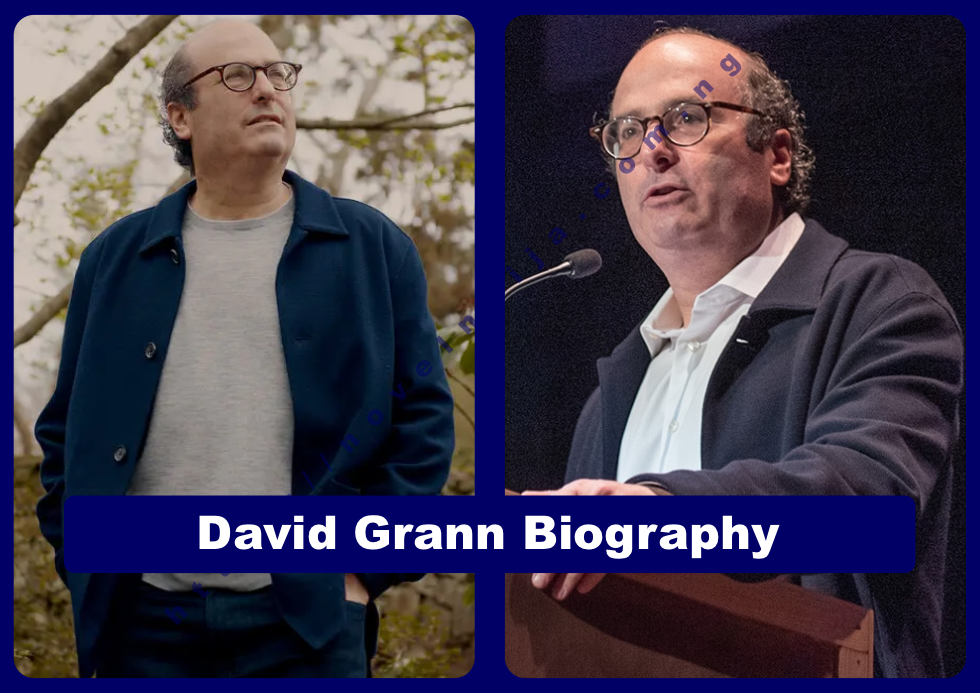
Explore David Grann’s journey from New Yorker staff writer to bestselling author. Discover his acclaimed works, Scorsese adaptations, and legacy.
David Elliot Grann is an American journalist, a staff writer for The New Yorker, and author whose first book, The Lost City of Z: A Tale of Deadly Obsession in the Amazon, debuted on The New York Times bestseller list at number four before reaching number one. What sets Grann apart in an era of declining long-form journalism is his ability to transform forgotten historical episodes into page-turning narratives that feel more like thrillers than history lessons.
I remember reading The Lost City of Z years ago and being struck by how Grann managed to make a century-old exploration mystery feel urgent and relevant. His work reminds us that truth, when told well, can be more compelling than any fiction—a philosophy that has guided his entire career and made him one of the most influential narrative nonfiction writers of our time.
Key Details Of David Grann Biography
| Field | Information |
|---|---|
| Full Name | David Elliot Grann |
| Date of Birth | March 10, 1967 |
| Age | 57 years (turning 58 in 2025) |
| Place of Birth | New York City, New York, USA |
| Nationality | American |
| Occupation | Journalist, Author, Staff Writer |
| Current Position | Staff Writer, The New Yorker (since 2003) |
| Education | Connecticut College (B.A. Government, 1989)<br>Tufts University – Fletcher School (M.A. International Relations, 1993)<br>Boston University (M.A. Creative Writing, 1994) |
| Spouse | Kyra Darnton (m. 2000) |
| Children | Two (Zach and Ella) |
| Notable Works | The Lost City of Z, Killers of the Flower Moon, The Wager |
| Net Worth | Estimated $5-7 million (2025) |
| Awards | George Polk Award (2009), Edgar Allan Poe Award (2018) |
Early Life and Background
David Elliot Grann was born on March 10, 1967, in New York City to Phyllis E. Grann and Victor Grann. His mother was the former CEO of Putnam Penguin and the first woman CEO of a major publishing firm, while his father was an oncologist and Director of the Bennett Cancer Center in Stamford, Connecticut.
Growing up in a household where books and medicine were equally valued, Grann developed an early appreciation for both storytelling and rigorous investigation. His grandmother would recount stories of his grandfather, a Russian furrier and freelance National Geographic photographer who traveled through China and Tibet in the 1920s. These tales of adventure and discovery planted seeds that would later blossom into Grann’s own fascination with explorers, mysteries, and forgotten histories.
Grann has two siblings, Edward and Alison, and the family environment emphasized intellectual curiosity and professional excellence. This foundation would prove instrumental in shaping his approach to journalism—meticulous, empathetic, and always in search of the human story behind historical events.
Education and Academic Journey
Grann graduated from Connecticut College in 1989 with a B.A. in Government. While still in college, he received a Thomas J. Watson Fellowship and conducted research in Mexico, where he began his career as a freelance journalist.
The Watson Fellowship year in Mexico proved transformative. Immersed in a foreign culture during a period of political upheaval, Grann began developing the reporting skills and cultural sensitivity that would later define his work. He explored different genres of writing during this period, even attempting fiction as an aspiring novelist.
In 1993, he received a master’s degree in international relations from the Fletcher School of Law and Diplomacy at Tufts University. In 1994, he earned a master’s degree in creative writing from Boston University, where he taught courses in creative writing and fiction.
This dual education in international relations and creative writing gave Grann a unique toolkit. The Fletcher School trained him to analyze complex systems and understand geopolitical contexts, while Boston University honed his narrative craft. This combination—analytical rigor married to storytelling artistry—became his signature.
Career Journey and Major Achievements
Early Journalism Career
In 1994, Grann was hired as a copy editor at The Hill, a Washington, D.C.–based newspaper covering the United States Congress. He was named The Hill’s executive editor in 1995. In 1996, Grann became a senior editor at The New Republic.
These early roles taught Grann the fundamentals of journalism in demanding, high-stakes environments. At The Hill, he learned to navigate the complexities of political reporting. At The New Republic, he encountered the world of intellectual magazine journalism, where ideas and arguments mattered as much as breaking news.
The New Yorker Era
He joined The New Yorker in 2003 as a staff writer. This move marked the true beginning of Grann’s ascent to literary prominence. The New Yorker gave him the time, resources, and editorial support to pursue the kind of deep, immersive reporting that would become his trademark.
His early pieces for the magazine demonstrated remarkable range. He wrote about a 79-year-old bank robber’s final heist, the antiquated water tunnel system beneath New York City, white supremacist prison gangs, and the death of a Sherlock Holmes fanatic. Each story combined meticulous research with cinematic narrative pacing.
Awards and Recognition
In 2009, he received both the George Polk Award and Sigma Delta Chi Award for his New Yorker piece “Trial By Fire”, about Cameron Todd Willingham. This investigation into whether Texas executed an innocent man showcased Grann’s commitment to uncovering injustice and was later cited by Supreme Court Justice Stephen Breyer in his opinion regarding the death penalty.
Another New Yorker investigative article, “The Mark of a Masterpiece”, raised questions about the methods of Peter Paul Biro, who claimed to use fingerprints to help authenticate lost masterpieces. Biro sued Grann and The New Yorker for libel, but the case was summarily dismissed. The article was a finalist for the 2010 National Magazine Award.
Major Books and Literary Success
The Lost City of Z (2009)
Grann’s 2009 non-fiction book The Lost City of Z: A Tale of Deadly Obsession in the Amazon recounts the odyssey of the notable British explorer, Captain Percy Fawcett who, in 1925, disappeared with his son in the Amazon while looking for the Lost City of Z.
The book became a cultural phenomenon, reaching number one on The New York Times bestseller list and being translated into more than 25 languages. Grann didn’t just tell Fawcett’s story—he retraced the explorer’s steps, venturing into the Amazon himself to understand what drove Fawcett and dozens of subsequent searchers to obsession and death.
The 2016 film adaptation, directed by James Gray and starring Charlie Hunnam, Robert Pattinson, and Tom Holland, brought Grann’s work to an even wider audience.
Killers of the Flower Moon (2017)
In March 2014, Grann said he was working on a new book about the Osage Indian murders, considered “one of the most sinister crimes in American history.” His book Killers of the Flower Moon: An American Crime and the Birth of the FBI was published in 2017.
The book documented how the Osage people, made wealthy by oil discovered under their land in Oklahoma, became targets of a systematic campaign of murder and manipulation in the 1920s. Grann’s investigation uncovered a conspiracy far more extensive than previously known, revealing how dozens of Osage were killed for their wealth.
It was a finalist for the 2017 National Book Award and later became number one on The New York Times bestseller list. The book also won the Edgar Allan Poe Award for Best Fact Crime.
The film adaptation, Killers of the Flower Moon, was directed by Martin Scorsese and released in October 2023, starring Leonardo DiCaprio, Lily Gladstone, and Robert De Niro. The film received widespread acclaim and brought this forgotten chapter of American history into mainstream consciousness.
The Wager (2023)
The Wager: A Tale of Shipwreck, Mutiny and Murder, was published in April 2023. It debuted at number one on The New York Times bestseller list and the hardcover stayed on the list for 65 weeks.
The book tells the true story of British naval officers and crew who became stranded on a desolate island off the coast of Patagonia in 1741 and descended into murderous anarchy. What makes The Wager particularly fascinating is how Grann examines how different survivors told completely different versions of events—each shaping their narrative to avoid being hanged for mutiny.
A reviewer in The Guardian wrote, “The Wager is one of the finest nonfiction books I’ve ever read”.
Other Notable Works
A collection of twelve previously published Grann essays, The Devil and Sherlock Holmes: Tales of Murder, Madness, and Obsession, was published in March 2010. Another book, The White Darkness, was published in October 2018.
The White Darkness documented modern explorer Henry Worsley’s quest to traverse Antarctica alone, following in the footsteps of his hero, Ernest Shackleton. The story is being adapted into a series for Apple TV+ starring Tom Hiddleston.
Film Adaptations and Hollywood Success
Several of Grann’s works have been adapted into major films:
- The Old Man & the Gun (2018), directed by David Lowery and starring Robert Redford and Sissy Spacek
- Trial by Fire (2018), directed by Edward Zwick, starring Jack O’Connell and Laura Dern
- The Lost City of Z (2016), directed by James Gray
- Killers of the Flower Moon (2023), directed by Martin Scorsese
These adaptations have introduced Grann’s work to millions who might never have picked up his books, while also providing substantial financial returns that have contributed to his estimated net worth of $5-7 million.
Personal Life and Family
David Grann was married to Kyra Darnton in 2000. Kyra Darnton is the President and Executive Producer of Retro Report, a non-profit news organization that produces documentary films exploring the history and context of current events. She is the daughter of John Darnton, the Pulitzer Prize-winning journalist.
David Grann is blessed with two children; Zach and Ella. The family resides in New York City.
Grann is known to be deeply private about his personal life, preferring to keep the focus on his work rather than his family. However, those who know him describe a man who balances the intense demands of investigative journalism with a commitment to his family and a passion for reading fiction, particularly detective novels and mysteries.
Writing Style and Methodology
Grann’s reputation as a journalist is built on his tireless research and immersive reporting. He doesn’t just read archives—he travels to the locations he writes about, experiences the environments his subjects encountered, and interviews dozens or even hundreds of sources.
For The Lost City of Z, he ventured into the Amazon. For The Wager, he traveled to the remote Chilean island where sailors were stranded. This commitment to firsthand experience gives his writing an authenticity and visceral quality that armchair historians cannot match.
His writing style has been described as spare yet evocative, building tension through carefully structured narratives that read like thrillers. He has an uncanny ability to make readers care deeply about events that happened decades or centuries ago.
Legacy and Impact
David Grann has redefined narrative nonfiction for the 21st century. At a time when long-form journalism is supposedly dying, his work proves there’s still a massive audience for deeply reported, beautifully written stories about the past.
His books have done more than entertain—they’ve sparked important conversations about historical injustice, particularly in Killers of the Flower Moon, which brought national attention to crimes against the Osage that had been largely forgotten. The book influenced how Americans understand their history and the treatment of Native peoples.
Grann has inspired a new generation of narrative journalists who see that rigorous reporting and compelling storytelling aren’t mutually exclusive. His success has also demonstrated that there’s a viable career path for writers who want to do ambitious, time-intensive projects rather than chase daily news cycles.
Interesting Facts and Lesser-Known Details
- Grann initially wanted to be a novelist and studied creative writing before fully committing to journalism
- He spent a year in Mexico on a Watson Fellowship, which launched his journalism career
- His mother was the first female CEO of a major publishing company
- Grann’s grandfather was a National Geographic photographer who traveled through China and Tibet in the 1920s
- He taught creative writing at Boston University before joining The New Yorker
- The Wager stayed on The New York Times bestseller list for 65 weeks
- Grann prefers reading fiction over nonfiction in his personal time, especially detective novels
- He was a finalist for the Michael Kelly Award in 2005
- Several of his New Yorker articles became the basis for Hollywood films even before he wrote full books
Conclusion
David Grann stands as one of the most important narrative journalists of our time. His ability to excavate forgotten histories and present them with cinematic urgency has not only won him commercial success and critical acclaim but has also changed how we understand American history.
What makes Grann’s work remarkable isn’t just his storytelling skill—though that’s considerable—it’s his commitment to uncovering truths that powerful institutions would prefer remain buried. From the wrongful execution explored in “Trial by Fire” to the systematic murders of the Osage people in Killers of the Flower Moon, Grann’s journalism serves a moral purpose beyond entertainment.
As Martin Scorsese’s adaptation of Killers of the Flower Moon introduces millions more people to Grann’s work, his influence will only grow. In an age of shortened attention spans and superficial content, Grann proves that audiences still hunger for deep, meticulously researched stories about who we are and how we got here. His legacy is ensuring that the past doesn’t stay buried—and that we learn from the darkness we’d rather forget.
FAQs
Who is David Grann? David Grann is an American journalist and bestselling author who serves as a staff writer for The New Yorker magazine. He is known for narrative nonfiction works that explore historical mysteries and true crime.
What is David Grann known for? Grann is best known for his books The Lost City of Z, Killers of the Flower Moon, and The Wager, all of which became number one New York Times bestsellers and have been adapted or are being adapted into major films.
What is David Grann’s net worth? As of 2025, David Grann’s net worth is estimated to be between $5 million and $7 million, earned through book royalties, journalism, film adaptation rights, and speaking engagements.
Is David Grann married? Yes, David Grann has been married to Kyra Darnton since 2000. They have two children together and reside in New York City.
What are David Grann’s biggest achievements? Grann’s major achievements include winning the George Polk Award and Edgar Allan Poe Award, having three number one New York Times bestsellers, being a National Book Award finalist, and having multiple books adapted into major motion pictures by directors like Martin Scorsese and James Gray.
Leave a Reply